

Guinness: The Irish Icon Among Stout Beers
Guinness is an Irish icon and is considered the world’s number one stout. It is far more popular outside of Ireland than within the country and is exported to over 150 countries. Every day, a staggering ten million pints are consumed worldwide. Yet, originally, Guinness was simply a product born by chance.
From ale to the most popular stout
The foundations of Guinness beer were laid as early as 1759, when brewer Arthur Guinness I signed a lease for the St. James’s Gate brewery, which was then in disuse. This lease was anything but ordinary: it was for a term of 9,000 years. Arthur Guinness initially produced ale, but soon attempted to replicate porter, which was very popular in England at the time. It was during these experiments that Guinness beer finally came into being. The recipe was so successful that the first shipment of dark beer was exported in 1769.
Today, the classic combination of dark liquid and beige foam captivates the entire world. At the Dublin brewery alone, four million pints are bottled and kegged every day. In total, 35 breweries around the world produce Guinness. The largest market for Guinness is not Ireland, but the United Kingdom, followed by Ireland, the United States, and sub-Saharan African countries such as Nigeria and Cameroon.
The secret of the dark color
The ingredients of Guinness have remained the same since it was first brewed by Arthur Guinness I: water, hops, barley, and yeast. The barley is of Irish origin; it is malted and roasted, and it is this barley that gives the beer its dark color. Strictly speaking, Guinness is not black, but ruby red. The roasted barley gives the beer such an intense ruby red color that it appears black in the glass.
Another distinctive feature is that Guinness production uses more hops than most other beers. Another secret lies in the Guinness yeast cultures, which are harvested before each fermentation and reused for the next batch. It is said that even today, every glass contains descendants of the yeast cultures from the very first Guinness ever produced.
The Irresistible Creamy Head
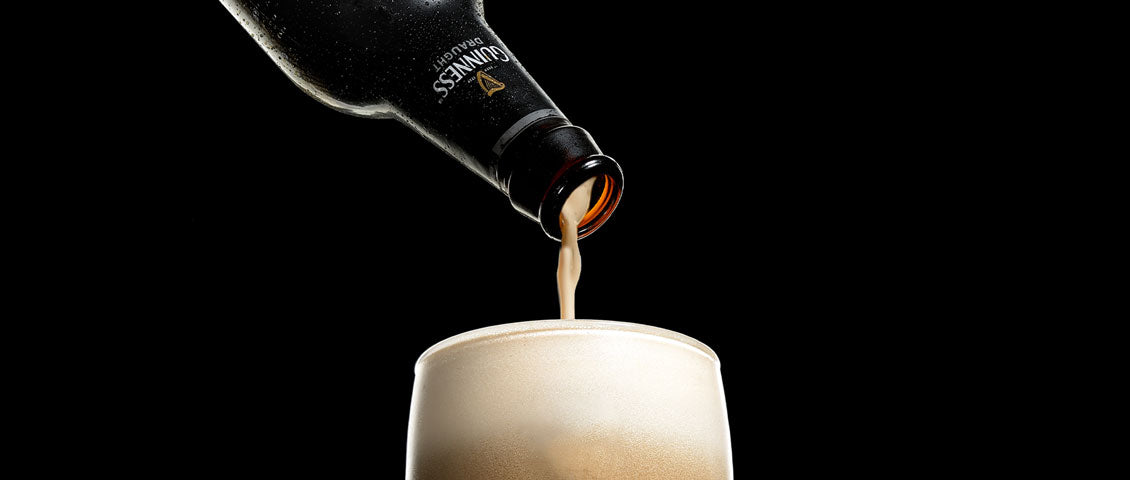
In Ireland, beers are generally poured quickly so that no head forms. With Guinness, it’s different. It’s poured using a special Irish pouring technique that employs a gas mixture, which produces that irresistible crown of creamy head. This dark, creamy head is typical of Guinness and is an integral part of it.
In Ireland, Guinness foams even when drunk from a can. This effect is achieved by the bursting of a plastic capsule located at the bottom of the can, which ensures the beer flows out as if it had just been poured. This capsule, called the “Floating Widget,” is filled with nitrogen during bottling and opens when the can is opened due to the change in pressure.
Six steps to a perfect pint
Every job well done takes time. It takes 119.5 seconds to pour a Guinness. Here are the six steps to a perfect pint:
- The right glass
: Guinness lovers prefer to enjoy their pint in the original glass, which guarantees a perfect creamy head. - 45-degree angle
: Hold the glass at a 45-degree angle under the tap. - Fill three-quarters full
: pour until the glass is three-quarters full, or up to the middle of the Guinness logo. - Let it rest
: let the glass rest for one minute so the bubbles settle. - Fill
the glass: Place the glass back under the tap and fill it until the head forms a slight dome. - Decorate
: Use the tap’s stream to decorate the head of foam with a three-leaf clover, Ireland’s national symbol.
There you go, the perfect pint of Guinness is ready. Sláinte! That’s how you say “cheers” in Ireland, which can be translated as the German word “Gesundheit.”